
LOCAL STORM DATA · 2021–2025
Arkansas Storm Damage & Fallen Trees: NOAA Data for Little Rock
70 Pulaski County thunderstorm-wind reports described damaged trees or limbs over five years.
Published October 11, 2026 · Analysis by Little Rock Tree Removal Pros · Study area: Pulaski County, Arkansas
Storm-related tree damage around Little Rock is not limited to tornadoes. Our review of NOAA’s Storm Events records found 70 reports mentioning tree, limb, or branch damage among 91 thunderstorm-wind reports for Pulaski County during 2021–2025. Those 70 reports occurred on 29 distinct calendar dates. They describe blocked roads, trees on houses, broken limbs, and trees bringing down power lines.
This is an independent analysis of public NOAA records, not a NOAA publication or endorsement. The counts refer to database event records—not individual fallen trees, insurance claims, customer calls, or 70 separate storms. The study covers Pulaski County, including communities outside Little Rock city limits. It does not measure all storm damage across Arkansas.
Year-by-year findings · Local examples · Methodology and downloads
Pulaski County tree-damage reports by year
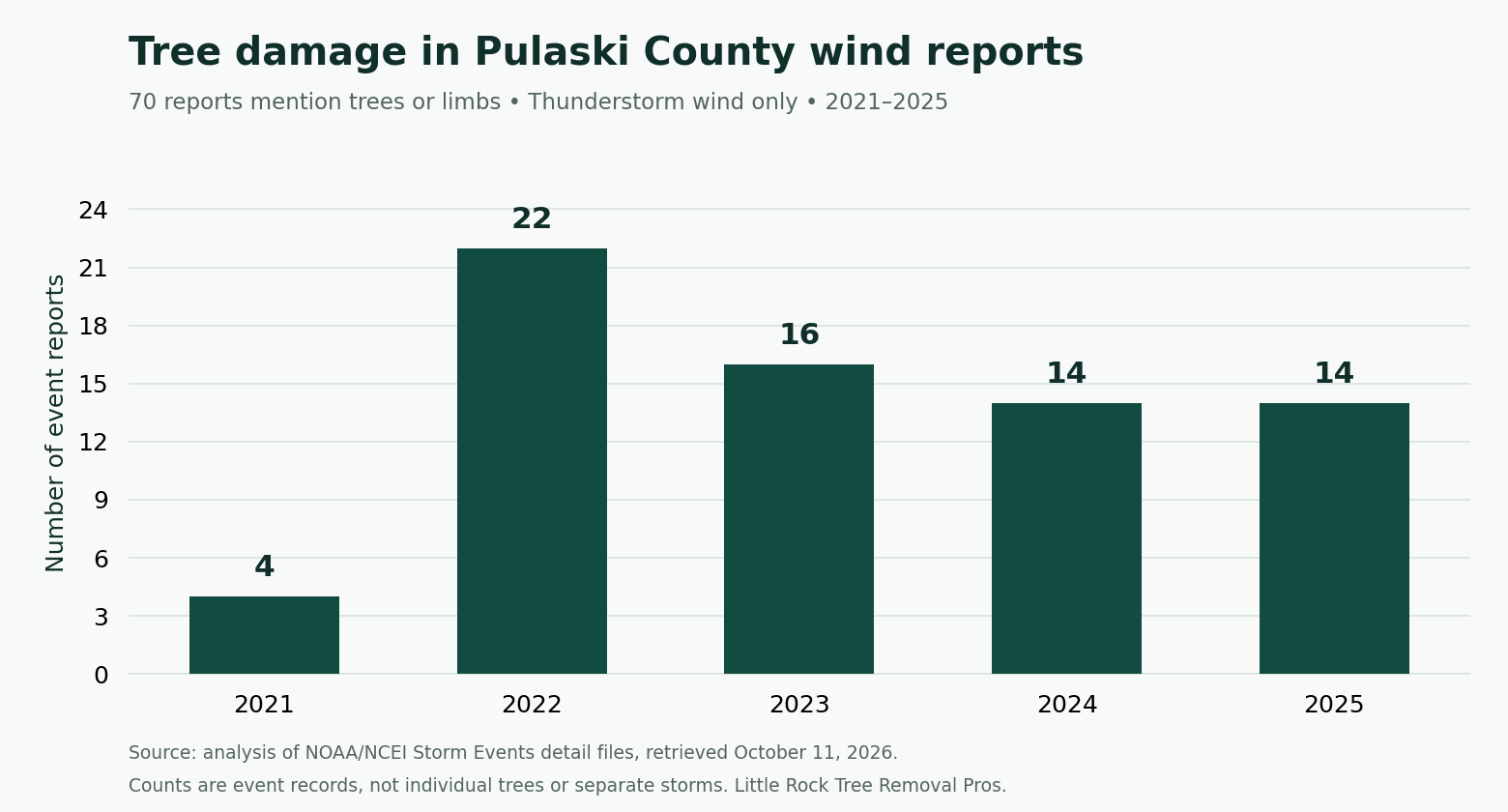
| Year | All wind reports | Reports describing tree/limb damage | Dates with tree/limb damage reports |
|---|---|---|---|
| 2021 | 5 | 4 | 4 |
| 2022 | 26 | 22 | 8 |
| 2023 | 21 | 16 | 5 |
| 2024 | 18 | 14 | 7 |
| 2025 | 21 | 14 | 5 |
| Total | 91 | 70 | 29 |
Approximately 77% of the selected wind reports mentioned tree or limb damage. That percentage describes the contents of this set of records. It is not the chance that a tree will fall during a storm, nor the percentage of homes affected.
2022 had the largest number of matching records, with 22. Multiple reports can come from one weather episode, and reporting detail can vary. A higher count does not establish that a year had stronger winds, more damaged trees, or greater financial losses. Likewise, the four matching reports in 2021 do not mean only four trees were damaged.
What the local reports actually describe
These examples are paraphrased from the event-specific narratives in the downloadable records. Event IDs let readers locate the underlying NOAA entries and distinguish one report from another.
- April 13, 2022 — Hillcrest: Event 1015858 describes uprooted trees and snapped limbs on C Street in Little Rock. Nearby records from that day describe other locations; they should not automatically be treated as separate storms.
- June 25, 2023 — North Little Rock and Sherwood: Event 1113807 records trees down in Burns Park. Event 1114200 describes trees and power lines down in Sherwood. The records show damage at multiple locations during the same afternoon.
- April 8, 2024 — near Scott: Event 1166398 describes a National Weather Service damage survey identifying a microburst with gusts up to 90 mph. The narrative reports uprooted trees and damage to several homes. This is classified as thunderstorm wind, not a tornado.
- April 5, 2025 — Sherwood: Event 1265100 describes a large limb penetrating the roof of a home. It illustrates why limb damage matters even when a report does not describe an entire tree falling.
- June 30, 2025 — near Gibson: Event 1279940 describes fallen trees and limbs along Jacksonville-Cato Road, including oak and pine trees. The narrative identifies a damage pattern consistent with a microburst.
The location labels in NOAA’s records can be nearby named places rather than exact municipal boundaries. We retained NOAA’s original labels in the download and used the narrative to describe these examples. We have not converted the records into a neighborhood risk ranking.
Tree damage is not only a spring concern
In this five-year sample, April had 24 matching reports, June had 15, and May had 12. Together, those three months accounted for 51 of the 70 reports. But matching records also occurred in January, February, July, August, September, and November.
These observations support planning beyond a single season. They do not predict the next storm or establish a long-term climate trend. Several reports from one active day can strongly influence a small sample. Use current National Weather Service Little Rock forecasts and warnings for present conditions; this historical report is not a live alert service.
What homeowners can do with this information
Use the examples to prepare useful questions about your property. Do you have a tree beside the house, branches over a driveway, or trees near overhead lines? A countywide report cannot determine whether any particular tree is safe. Describe concerns to a qualified tree-care professional and ask what assessment is appropriate.
During a wind warning or severe thunderstorm warning, prioritize shelter. The National Weather Service’s high-wind guidance advises moving inside a sturdy building and staying away from trees and power lines. Afterward, its post-storm guidance warns against approaching downed lines and urges caution around debris.
If there is an immediate threat to life, call 911. Report downed lines to the utility or emergency authorities and stay clear of the area. Do not approach a damaged tree to take better photos, climb it, or attempt to cut a suspended limb. This website’s project-request number is not an emergency dispatch service.
Once you can observe the situation safely, record the location and what you can see: a blocked driveway, a tree resting on a structure, broken limbs, or possible utility involvement. Photos from a safe position can help explain the request. A provider must decide what inspection, equipment, access, and removal plan are needed.
For planning questions, see our Little Rock tree removal guide, equipment access and cleanup checklist, and tree removal cost factors. Ask whether wood hauling, stump grinding, and ground restoration are included; they should not be assumed from a general promise to remove a tree.
Methodology: how we counted the reports
- Source and period: We downloaded the NOAA National Centers for Environmental Information Storm Events “details” files for 2021, 2022, 2023, 2024, and 2025 on October 11, 2026. Each annual source file contains records through December. We excluded the incomplete current year, 2026.
- Geography and event type: We selected Arkansas (STATE_FIPS 5), county-coded records (CZ_TYPE C), Pulaski County (CZ_FIPS 119), and EVENT_TYPE “Thunderstorm Wind.” This produced 91 unique EVENT_ID values. County-coded and forecast-zone-coded records were not mixed.
- Tree-damage identification: We searched EVENT_NARRATIVE, case-insensitively, for the whole words tree, trees, limb, limbs, branch, or branches. We then read all 70 matching narratives to confirm each described damaged or fallen trees or limbs. We did not use the broader EPISODE_NARRATIVE, which can describe damage outside the county.
- Counting: Each unique event ID counts once, even when the narrative describes several trees. We grouped by event year. The date count uses the date portion of BEGIN_DATE_TIME as supplied by NOAA, without converting time zones; CZ_TIMEZONE is retained in the downloadable file.
- Transparency: The event download includes all 91 selected wind records, their original event narratives, yes/no tree-damage flags, event and episode IDs, and the corresponding source filenames and URLs.
Limits of this analysis
This is a count of documented reports, not a complete inventory of fallen trees. Unreported damage, a narrative that omits tree damage, or wording outside our search terms will not appear in the tree-damage count. Tornadoes, ice storms, lightning, and other event categories are excluded even when they damaged trees. One date may contain several storms, and one storm can produce several records.
We did not calculate tree-removal costs or sum property-damage estimates: the records do not isolate those costs consistently. This five-year comparison cannot demonstrate a change in climate, measure the safety of a neighborhood, or predict demand for a contractor. NOAA may revise historical records; the source versions below identify the snapshot used.
Download the data and check the sources
- Download all 91 wind records with tree-damage flags (CSV)
- Download the annual summary (CSV)
- Download the yearly chart (PNG)
- NOAA/NCEI Storm Events Database and bulk data directory
- NWS Little Rock monthly storm reports and Storm Data
Exact annual source files used
Questions about the findings
Does 70 reports mean 70 trees fell?
No. One record can mention a single limb or many trees. Our count measures records describing tree or limb damage, not the number of affected trees.
Does this include the March 2023 Little Rock tornado?
No. The main analysis selects thunderstorm-wind records only. Tornado damage belongs to a different event category and is outside these totals.
Can a publisher cite this report?
Yes. Identify the figures as Little Rock Tree Removal Pros’ analysis of NOAA/NCEI Storm Events records for Pulaski County, 2021–2025, published October 11, 2026. Link to this report so readers can review the method, source versions, and downloadable records. Keep “reports” in the description rather than calling the counts trees or storms.
About this report
Little Rock Tree Removal Pros is an independent referral website. We prepared this report to make public storm records easier to understand locally; we did not perform the weather observations or damage surveys. NOAA and the National Weather Service are the source organizations and do not sponsor or endorse this website.
Send corrections through Contact & Help, preferably with the event ID and the detail in question. For a non-emergency tree-work inquiry, leave your project details or call (501) 501-8593. A separate provider must assess the work and supply any estimate. Provider availability, appointments, and callbacks are not guaranteed.
Planning work after a storm
For a current property concern, use our Little Rock storm-removal planning guide to distinguish urgent hazards, public-road reporting, and private cleanup. The tree service overview explains routine removal, pruning, and stump options.